Is Java a World Language?
Most high schools require that students take two to three years of a world language. But what constitutes a world language -- do programming languages qualify?
Most high schools require that students take two to three years of a world language for the purposes of expanding their cultural and communications skills, and being competitive when applying to universities. But what constitutes a world language? Must it be a spoken language, or can it be something else, say, American Sign Language, or a computer programming language? Who decides what counts?
As schools work to evolve curriculum and employ technology in ever more meaningful ways, I mulled over my own experiences with world language courses and the impact they’ve had in my life. Having been raised in San Antonio, it would have been prudent for me to take Spanish -- more than 60% of my hometown was Hispanic, and I could have practiced it constantly -- but my mother signed me up for French, viewing the language of the United Nations as the more international of my two options. L'horloge de l'église son. Din don din. I still recall those words from my French children's reader used in Madame Bagge's fifth grade class. Throughout high school, I continued with French off and on, and thank goodness I did because in 1985, during my freshman year at the University of Texas, only four languages were accepted for entry into my math degree program -- and Spanish wasn't one of them. French, German, Russian, and Japanese were the "in" languages at that time. But that would change.
What world languages are "in" depends on the decade. During the early nineties, when graduation criteria were strengthened, new world language requirements (and science, too) were implemented across the nation. Many schools simply didn't have the staff to comply. That's when solutions including TI-IN Network, a tele-education provider, stepped in. Our team of teachers instructed on-air daily, via satellite, to locales from rural Texas to the Florida Panhandle to the Upper Peninsula of Michigan. I taught Physics, but I worked alongside teachers of Spanish, German, French, Latin, Japanese, and interestingly, American Sign Language. (ASL often confounded the television control room with directors struggling to check sound levels on a broadcast with no audio.) Demand and the assurance that a language would bear credit in a student's local school district determined which languages TI-IN offered. And as evidenced by the ASL example, the language choices weren't all spoken.
These days, we see an expanded set of language offerings, including exotic choices from Hebrew to Mandarin to Arabic, offered formally in schools and online. Informal providers, such as Rosetta Stone, have options including Irish and Swahili, as does DuoLingo. The latter also weirdly includes Klingon in its language courses; acquire proficiency in this (not-of-this) world language, and you'll be able to pe’vIl mu’qaDmey (curse well!). I’d guess that the all-consuming rage of Game of Thrones (who says it’s over?) will see the addition of the Dothraki language to some provider’s available course list. The full catalog of world languages is big, but access to instructional and translation tools, including Google Translate, is making it easier than ever for humanity to converse. On a daily basis, I hit the "Translate" button on Facebook posts from friends in Turkey and Israel, so that I can read and enjoy their posts -- yet I speak neither of their languages. That doesn't devalue the process of learning and appreciating another language, but it does facilitate communication and offload humans from the impracticality of learning the many languages of Earth (ostensibly arising from man's hubris in building the Tower of Babel as told in Genesis... those naughty engineers, always trying to build a taller tower).
So what, if any, world languages should high schools offer, and what should be the goal in learning them? Before you answer, consider another definition of a "world language." For nearly all of humanity's (and schools') existence, the forms of language-mediated communication were those which transpired between and among people. Speaking, singing, writing, and reading existed only in the form of human languages, and possessing these skills signified literacy. (Okay, I'll cede that dolphins, birds, dogs, apes and other animals employ their own forms of speaking and singing -- and Koko the Gorilla signs in ASL! -- but unless they're attending your local high school, that's a different topic...) Now in 2019, there's "someone else" to talk to, and that someone isn't an organic life form -- it's a machine. Human are still talking to each other, but we're also talking to machines, and our communications are mediated through computer programming, or coding, languages. We're not talking about just a few machines, such that only a couple of computer science scholars are needed to communicate in code. Humans are losing in the human:computer ratio, with so many new Internet of Things (IoT) devices in the world that we've had to expand the addressing system to enable communication with them all. Why wouldn't we recognize the need and value of learning to communicate in computer programming languages? It's time to acknowledge the evolution in communication that's taking place: everything from Scratch to Java is a legitimate "world language" -- and high schools need to catch up and recognize them as such.
The Atlantic's recent article, Does Coding Count as a Foreign Language? (2016), examines a proposal by the Florida legislature to allow students to count computer programming languages as their world languages. The rationale is utilitarian: we need more coders in this country and allowing students to go this route will fulfill an economic need. The reaction (as you might predict) has been resoundingly negative, mostly emphasizing the impending death of the Humanities at the hands of the evil STEM automatons, and the failure of those dumb legislators to understand that "real languages" are beautifully complex organisms possessing thousands of words for expressing abstract thoughts, while programming languages have only a vocabulary of 100 words and are really just cold math equations disguised as words. But I'll argue that both the communication and creativity that programming languages facilitate is every bit as important as traditional human languages. What other communications medium has consumed our attention more powerfully than the apps running on our mobile phones and laptops, and how were those apps created? How does something comprised of vocabulary, syntax, and punctuation, that combines parts into wholes to produce richer meaning and fully engage humanity (as we know it does) not qualify as a language?
Don't our students deserve more flexibility, not less, as they work through their already standards-heavy, American high schools and plan for their futures? Many will choose a traditional world language from the currently available slate of what's considered "in," with a few embracing that language and gaining some actual ability in it (I did!). But most will tick the box for "world language" on their list of graduation requirements and be done with it. So why not offer them an alternative and add computer programming languages to the list of authorized world languages required for graduation?
When Ari, one of my former AP Computer Science A students, wrote her Sadie's "ask" poster in Java to Matthiew, he understood the language in which it was written -- and valued their shared ability to communicate in a language other than English. It exemplifies the case that a computer programming language can represent something more than cold hard code. Like other world languages, Java is beautiful in the hands of a skilled communicator who can use it to create some new that makes meaning... whether it's an app or an invitation to a high school dance.
(photo credit: Jason Bello)
Schools, Showcase Your Teachers
Human capital matters. Showcase your teachers to parents, and potential parents, frequently.
What does it take to sell a progressive, independent high school when AP and SAT scores don’t tell the whole story? And how do nontraditional middle schools – which don’t even have such data points (and can’t tally college admissions) – demonstrate their worth and success?
As schools migrate to “21st century instruction,” in which soft skills and project-based learning are foundational, accessing a school’s merit becomes more challenging to quantify. Parents debating hefty tuitions for their children’s education want to know their investment is sound. They may intuit that preparing their kids to flex and pivot in the messy career world requires more from schools than antiquated drill-and-practice – but their own experiences in traditional institutions may cloud their abilities to judges what matters now.
One of the most actionable ways in which schools can convey their qualitative worth, and ultimately sell the value of their unique educational offerings to families, is to showcase its teachers.
Extraordinary teachers don’t just clock-in for nine months of the year. They train constantly, via self-study, advanced coursework, and fellowships, and they engage in their careers by publishing and presenting at professional conferences as well as mentoring others. Extraordinary teachers adjust and adapt their curriculum and instruction to connect with the actual students in the room, and they make their instruction relevant to recent events in the world around them. One administrator with whom I once worked marveled at an English teacher who, “had every minute of her day-by-day curriculum mapped out from September to May.” But while detailed planning is admirable, an inability and unwillingness to pivot and update, irrespective of subject area, indicates either a lazy teacher or a static content field. (In either case, there’s no need for a human at the helm: a robot is coming for that job.)
Extraordinary teachers also work to build in their students the skills and habits of adult professionals operating in the real world, adjusting to meet the age-appropriate needs of their learners. Herma de Ridder, a science teacher instructing early elementary students at the Alexander Dawson School (Las Vegas), coaches children as young as age five to keep a lab notebook tracking every experiment and observational study they conduct. She helps her students learn and use new vocabulary in context; plan their work by writing logical procedures (lovingly correcting their “kid spelling” in the margins); draw diagrams of lab setups; attach and label photos and collected samples; and draw conclusions from their findings. In short, she trains them to behave as scientific thinkers. Saying that Herma teaches science is insufficient to capture the full story, but seeing is believing: Dawson showcases what that entails by regularly bringing parents into her lab, inviting parents on field trips, and sharing those lab notebooks with them throughout the year.
While years of teaching experience and degrees can contribute greatly to developing quality teachers, non-teaching career experience matters, too. Our high school technology lead, Leon Wilde, is a former pilot, Evernote entrepreneur, and lifelong tinkerer. The authenticity of those skills goes a long way in coaching our students to innovate in the Adelson Startup Incubator. In recent years, I’ve witnessed him guide high schoolers to build and fly UAVs, construct a chair befitting Marilyn Monroe, and design and fabricate a “volcacho” (solving the bare nacho problem with a volcano of spewed toppings). Who Leon is as a person and a professional, not just his curriculum delineated on paper, are vital value adds which shape the learning experience for his students – value adds we actively showcase beyond the Incubator. That showcasing consists of welcoming visitors, meeting with collaborative partners and vendors, representing the school in external events and contests, appearing in virtual tour videos, and working with parents on Dine and Design nights – all events that go beyond the “typical” teaching duty.
Don’t cloister your teachers in their classrooms, trotting them out before parents only on back-to-school night. Don’t sell your curriculum as though it can be divorced from instruction, with “just any teacher” operating interchangeably in your teaching positions. Human capital matters. Showcase your teachers to parents, and potential parents, frequently. In the end, connecting the dots among students, teachers, and parents will help the adults making the financial investment appreciate the value add of the guides mentoring their children… and continue to do so long term.
Where Education is Not “Business as Usual”
What does it take to create a school where teachers love to teach and students love to learn?
School in the 21st Century
My experiences as a student were a mixed bag of exhilarating and mundane. I constantly questioned, “What does it take to create a school where teachers love to teach and students love to learn?” and I still do so today. But I’ve come to believe that the answer is something along the lines of, “It takes joy, relevance, and choice in the teaching and learning process” – the same qualities we seek in our professional and personal lives. That’s why I am constantly working, along with my remarkable colleagues locally and around the world, towards making “school” a place where students find joy in their work, see its relevance in everyday life, and have choices about the paths of their educational trajectories. In crafting such teaching and learning experiences.
An Exceptional Educational Trajectory
During my childhood in San Antonio, Texas, my elementary school acquired a networked, computer terminal that churned out math problems, Jeopardy style, via dox matrix printing on form feed paper. A handful of kids were selected for weekly usage rotations on the device. This game show approach to drill-and-practice was riveting compared to regular class time, and I found creative ways to slip out to my allotted session early (and then stay late) to capitalize on my access to technology. A few years later, my parents purchased our first home computer – a Timex-Sinclair ZX-80 which used a television set as a monitor. Possessing only 4K of RAM, the device permitted me to write only short programs (in BASIC), but it sparked endless possibilities in my head of programs I could write someday when the technology would eventually evolve. Those experiences and the innovations associated with them jump started my thinking about both my own education and that of my peers. That thinking sometimes emerged as admiration for the inventive way a teacher would help us learn a new idea, and other times as dreaming up some other instructional method that was more engaging, more understandable, and more relatable than “traditional” classroom teaching.
In my teens, winning the Alamo Regional Science Fair provided a scholarship that allowed me to attend one of America’s top-ranked private schools, the Keystone School. With an elite cadre of fewer than thirty students per grade, my peers and I spent most school days immersed in captivating, cutting-edge learning: chemistry lab work, reading and debating the symbolism of everything from “Young Goodman Brown” to Rosencrantz and Guildenstern are Dead; dissecting a cat; writing and revising, followed by more writing, then enduring the weighing in of each research paper (insufficient heft meant not enough writing); programming in Fortran; and more. Between classes, my school day was filled with philosophical debates about Nietzsche, and introductions to emerging punk bands (as heard via Sony Walkman) in the school lounge. During free periods, Keystone high schoolers enjoyed off-campus privileges, often gathering in booths at the Charles Pharmacy Diner, where hot coffee and buttered tortillas accompanied intensive problem-solving for Sister Newman’s Pre-Calculus course. (Keystone was not religious… Sister Newman was a rebel nun who wore a habit but eschewed many of the more pious trappings of her faith.) Beyond the “normal” school day, the founder of the school, Coach Eargle, along with my parents, mentored my increasingly deeper dives in science fair. My research, conducted throughout high school on the Big Bang theory and the resulting geometry of the Universe, led to me compete in the International Science and Engineering Fair. And on any given weekend, my peers and I hopped on a bus and headed to competitions of all sorts, from math contests to French Symposium. It was a challenging, engaging education with extraordinary teachers and classmates (with whom I’m still in touch!) and it set in motion my entire life.
Removing the Roadblocks to Educational Innovation
My own educational experiences helped define my thoughts about what it takes to make education joyous, relevant, and full of choice. Soon after graduating from the University of Texas at Austin, I had the opportunity to put those thoughts into practice during my first teaching job, at a rural high school comprised of graduates matriculating to the military and farming. While pursuing an alternative route to teacher licensure, my tenure coincided with the Gulf War, and my students were both curious and concerned about the daily progress of the war. Over winter break, I asked the custodian to help me swap out desks for tables so the students and I could spread out copies of maps to mark terrain, draw flight plans, measure armaments in the region, compute the impact of ongoing strikes, and apply math and physics in as many ways as I could dream up from pouring over USA Today infographics and recording CNN (in VHS!) the night before each new day of classes. My students and I were invested, co-learners in a classroom-turned-situation-room. I worked as their guide to identify and provide real problems to tackle, dependent on the day’s news, and differentiated according to abilities and interests of our learning community. Class was engaging and different every day, and we were fortunate to have an administration that supported the idea that a learning environment – in the hands of a capable educator – can go off-script and connect instruction with the immediacy of current events. In this and other teaching opportunities, exciting instructional transformations were realized, in part, because the strong leaders above me removed the roadblocks to educational innovation.
America possesses a reputation for innovation. From slogans of giant companies – Apple’s “Think Different,” and General Electric’s, “Imagination at Work” – we celebrate progressiveness, freedom, and diversity. Yet most schools still doing what we’ve been doing since the days of chalk-and-blackboard classrooms. Since when did amassing thirty people in a classroom to deliver a unidirectional lecture amount to engaging learning? American students sense a deep disconnect between what they are doing at school and what they are doing in their lives. Innovative and adaptive approaches to teaching and learning are missing from most of our nation’s schools. The ability for schools to detach from standards as “the goal” in lieu of standards as “the framework” is fundamental to reimagining teaching and learning. Not every classroom must be a duplicate of the classroom next door. Simultaneously, schools must push back against the cloistering of teachers in their classrooms and the erection of “borders between disciplines” which are characteristic of most secondary institutions. Collaboration and convergence by teachers in their instruction – along with meaningful interactions with the youth engaged in that instruction – results in an educational cross-pollination that benefits all.
There is nothing wrong (and quite a bit right) with ensuring that every student passes an exam with baseline knowledge and skills – but this is not the best use of human teachers. At too many schools across our nation, the stuff of educational standardization has unwittingly become everything, the only thing. If students are trained only to regurgitate knowledge, even at a high level, they will be unprepared for the messy challenges that will inevitably confront them in their careers. No manager will hire and evaluate an employee on his ability to successfully answer ten multiple choice questions with 90% accuracy. The success of a worker and her company isn’t an AP exam. The role of schools now is to guide students in planning, negotiating, thinking critically, problem-solving, and make meaning with basic informational and computational “stuff.” Otherwise, why should students come to school at all, investing eight hours each day in something that seems to have little translation or application to their futures? In the end, a failure to align the teaching and learning experience with the ever-changing, inconsistent world – of government, science, entrepreneurial enterprises and “life” to which students exit – creates not just failing schools, but unprepared citizens and a faltering society.
A Progressive Education through Technology and PBL
At the Adelson Educational Campus, we don’t perpetuate an educational philosophy of business as usual. In my current role as Director of Technology and Curriculum Innovations for the Adelson Educational Campus in Las Vegas, we are reimagining what an elite, first-class, progressive education looks like. A key component of our restructuring efforts is the effective use of technology in teaching and learning. To this end, I collaborated with my tech team, our administration, our board, and a major donor to craft a new Technology Innovation and Integration Initiative that we are currently implementing throughout our preK-12 school. This initiative features three key components: one-to-world devices for every student and teacher; ongoing, intensive technology professional development for every teacher; and the construction of a 5000 square foot, state-of-the-art Startup Incubator employing a progressive coding, maker, and design curriculum which we invent (and re-invent) constantly. Invoking the latest research, current events, and emerging technologies, our instructors develop and update learning experiences on a daily basis, and evolve our work through honest evaluation and reflection. At $4M, this investment represents both a deep commitment to STEAM (Science, Technology, Engineering, Arts, Mathematics) and to an overhaul of the traditional educational paradigm. Students who emerge from school with the ability to understand, transform, and improve any system they confront trump those who have only experienced traditional school methods.
And our STEAM restructuring is only the start… we are implementing this progressive vision schoolwide at Adelson, integrating all disciplines to reflect the 21st Century world beyond the campus, creating authentic daily experiences in project-based formats that our students and teachers co-create. Ultimately, technology can facilitate our teaching and learning mission in two distinct ways: delivering knowledge-level information, offloading human teachers from repetitive lecturing, and providing students differentiated tools, such as flipped video content and quiz practice to master content at their own pace; and providing content, creation, collaboration, and communication technologies which allow learners to design, model, build, analyze, evaluate, and share information and ideas in powerful ways.
An example of these progressive uses of technology is an Arts and Incubator project that was recently conducted by our freshmen class, the Chair Project. The project also invokes the second key component of a progressive education, project-based learning (PBL), “a teaching method in which students gain knowledge and skills by working for an extended period of time to investigate and respond to an authentic, engaging and complex question, problem, or challenge.” After exploring a timeline of artistic movements throughout history, freshmen formed small teams, then selected a prominent person for whom they would design and fabricate a chair. A chair object was chosen for its simplicity of function, its variability of form, and its unique aesthetics with regard to user status, religion, culture, and other factors. Student research and debate led them to choose King Tut, Albert Einstein, Leonardo da Vinci, Marilyn Monroe, and Elijah as their “clients.” Invoking a design thinking methodology, freshmen brainstormed the sitting needs and stylistic preferences of each chair owner, empathizing virtually with their clients to plan the ideal custom chair for each person. Teams then employed Fusion 360 to digitally design small-scale versions of their chair creations for prototyping via 3D printing and cardboard construction. After fine-tuning designs and troubleshooting potential fabrication challenges, students employed authentic materials (e.g., wood, nails, fabric) and fabrication tools (e.g., saws, lathes, laser-cutters, sewing machines) to build their designs full scale. Through extensive mentoring from their teachers and thoughtful collaboration with their peers, freshmen teams completed impressive start-to-finish projects, producing real-world products, and developing hard and soft skills they will carry forwards into college and career. Students expressed tremendous satisfaction in their finished chairs, having found joy in their work, relevance in the process, and choice in multiple facets of the project.
Leaping Forwards
I once asked a colleague, the late Mike Wargo, who was chief exploration scientist for NASA’s Human Exploration Mission, how it was possible that the United States had met President Kennedy’s rapid turnaround goal of getting a man to the Moon… and yet we’ve made only incremental progress in rocketry in the fifty years following that success. His answer was that initially, we made a giant leap; but since then, we’ve just kept revising the same propulsion system, making tiny improvements, never realizing the paradigm shift that has to transpire to truly level up and make the next big leap. Without that leap, we are stuck in our own solar system, seeing through telescopes the many newly discovered planets we can inhabit, but never being able to get there because the forty light-year-distance is too far to cross.
Innovative schools can only be innovative if they create and act on a paradigm shift in education. They can’t make little tweaks. Only with the next big leap can we propel America’s students to the lead position on the world stage. We are leaping ahead at the Adelson Educational Campus. I wish every child, everywhere, could attend a school where that leap happens every day.
(first appeared in 2018 AEC Gala publication)
Leanne's Soccer Abstraction
“It seems obvious how abstracting the game can lead to me building a soccer app, or even writing control code for a soccer-playing robot." — Leanne
There’s a great story told by Electronic Arts co-founder Bing Gordon about his effort to gain John Madden’s endorsement of the company’s latest video game – football, of course – for the Apple II. In Video Game Invasion, Gordon describes how limited RAM of the era allowed for only seven players on each digital team. “Madden looked at it and said, where’s the other guys? That’s not football!” Gordon reports that Madden didn’t put his stamp of approval on the game until the technology had evolved sufficiently to program all eleven guys onscreen.
Analyzing the parameters of a game and translating it from the real-world, people-playing version to the mobile app realm, invokes a computer science concept called abstraction. Abstraction is, “establishing a level of complexity on which a person interacts with the system, suppressing the more complex details below the current level.” Inherent in the abstraction process of translating a sport to its digital analog is making concrete the complex action of the game. In addition to the gameplay itself, hardware and software constraints must be planned for, including memory allocation – something you really had to take into account when working with those early personal computers.
While coding is currently the big buzzword in education (and it has been posited that Every Child Should Learn to Code), the broader principles of computer science are equally important as writing lines of code using proper commands and syntax. Abstraction is one of those principles and it’s been the focus of my AP Computer Science Principles classes this week. For many students getting started with computer programming, though, the inevitable, “Why do I need to know this?” question pops up when venturing into non-coding turf. They just want to get on with making stuff. But for one of my students, Leanne, learning abstraction made perfect sense.
An athlete, scholar, and all-around amazing high school junior, Leanne had just presented her abstraction project on a theme of personal value to her, soccer. Working in Coggle to create a top-down analysis of “playing soccer” – including low-level specifics defining exactly how many bits are required to store each player name, field position, kick type, score, and more – Leanne transcribed her physical sport into its virtual form. “I love soccer, and I want to pursue robotics and programming, so it seems obvious to me how abstracting the game can lead to me building a soccer app, or even writing control code for a soccer-playing robot. This is not one of those times when I wonder when I’ll use this. I get it!”
Learning the broader, lateral reaches of the discipline (including concepts such as abstraction) ensures that Leanne and others enrolled in our AP Computer Science Principles Code.org course develop habits of the computer scientist, not just skills of a coder. And isn’t that who we want developing the next wave of apps for our world… practitioner programmers who are also big conceptual thinkers? Fortunately, with technology progressing fast and far beyond the era when John Madden put the kibosh on EA Games’ seven-man football, Leanne won’t have to modify her soccer abstraction to limit the number of players of the field. But if she gets those robots up and running, there may be a few players out of jobs. I just hope she saves some seats for us human spectators in the stands!
Most Likely to Succeed
Education. We all got one. What does it mean now to be educated, how do we structure school, and what makes the next generation, Most Likely to Succeed?
Posts
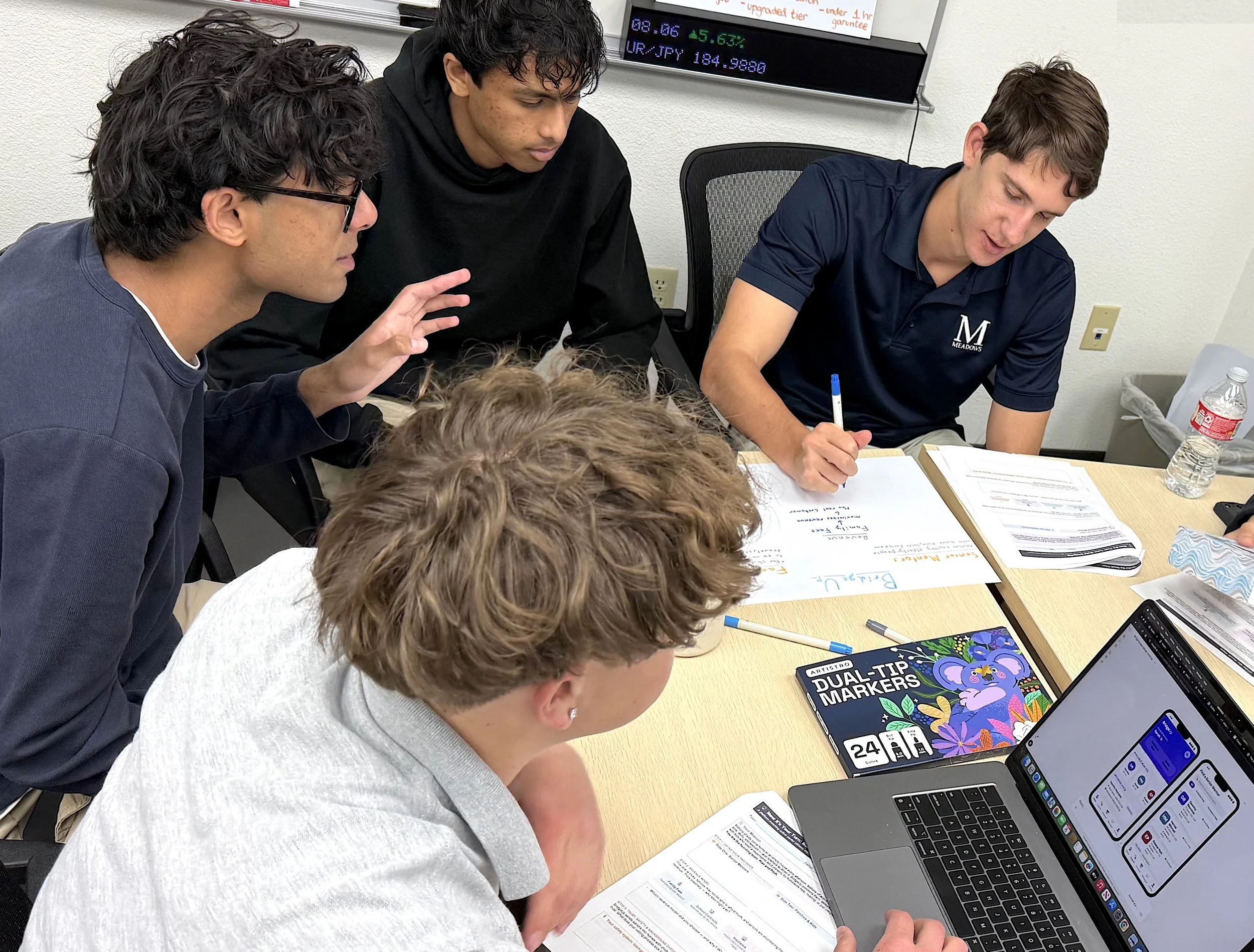
School’s out, but DECA advisors are already planning for next season. Prepare now for the challenge regarding ICDC absences. To colleagues, these feel egregious, as competitors spend only 15 minutes before judges while the rest is seen as “fun.” The frustration is real, but DECA conference engagement is about so much more than just competition. Here are the evergreen skills students are actually building.